When the way someone speaks becomes more important than what they are trying to address, accountability can disappear from the conversation.
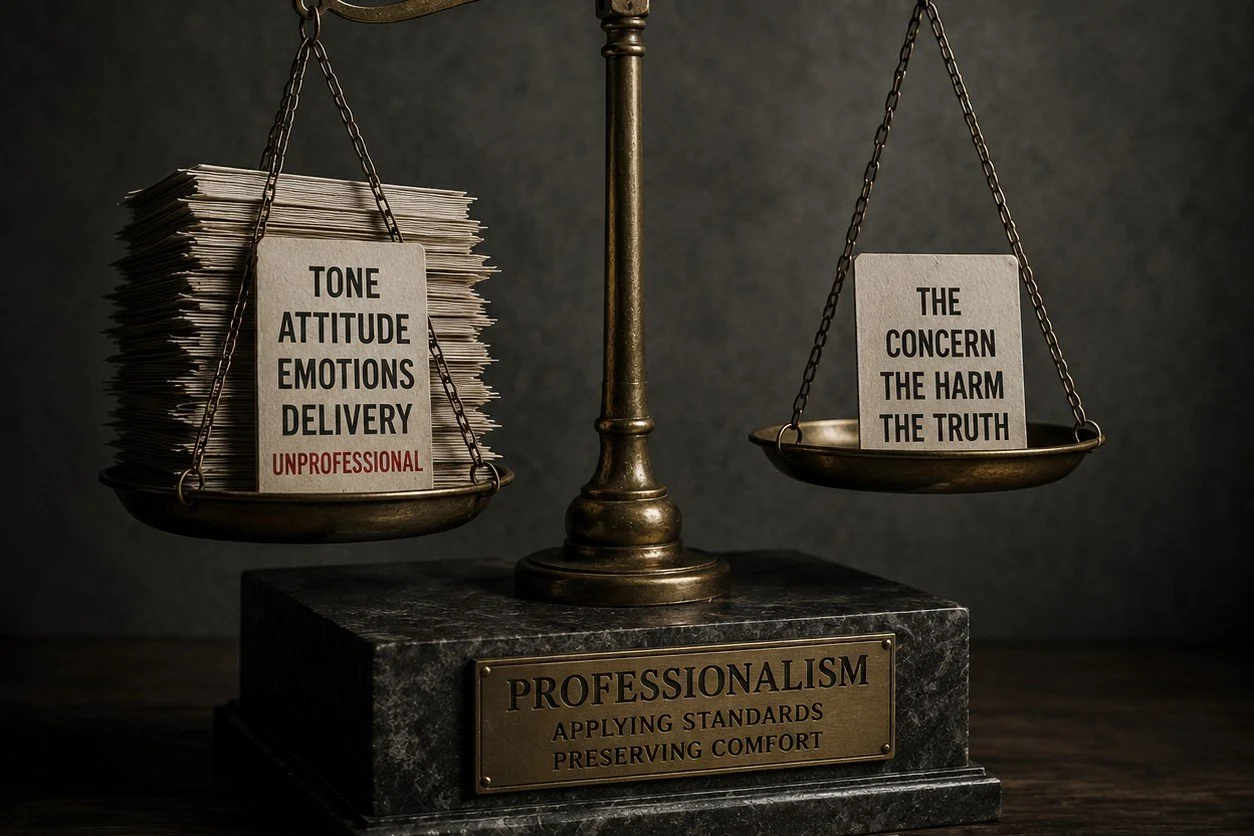
Sometimes the way a concern is expressed receives more scrutiny than the concern itself.
I've experienced how quickly conversations about unfair treatment, access barriers or difficult decisions can become conversations about attitude, tone and professionalism.
The original concern can become secondary.
Professionalism is meant to establish standards of respect, fairness and responsible conduct.
Those standards matter.
People should be able to work, communicate and raise concerns without experiencing intimidation, bullying or personal abuse.
But what happens when professional standards are applied selectively?
Consider someone who questions an inaccessible arrangement, challenges a decision or raises concerns about how they have been treated.
Instead of examining the issue, attention turns towards how the person communicated.
Were they too direct?
Did they sound angry?
Were they being difficult?
Should they have expressed themselves more calmly?
These questions may sometimes be relevant to how a conversation was conducted.
But they do not answer the original concern.
A person's manner of communication and the substance of their complaint are not the same thing.
Someone can communicate inappropriately while raising a valid concern.
Equally, someone can communicate politely while presenting information that is inaccurate or unfair.
Neither tone nor emotion determines whether the underlying issue is legitimate.
The facts still need examining.
For Deaf people, another layer can complicate these judgements.
Communication may take place through BSL interpreters, written English or other methods that do not always fit hearing people's expectations of how someone should communicate.
Direct questions, written wording or interpreted expressions may sometimes be perceived differently from how they were intended.
If those differences are not considered, assumptions about attitude can influence how someone's concerns are received.
But this is not exclusively a Deaf issue.
Employees, service users and others with less institutional power can also find themselves expected to remain calm, agreeable and measured while challenging decisions made by those with greater authority.
Meanwhile, the behaviour of people holding that authority may receive less scrutiny.
That raises an important question.
Are professional standards being applied consistently, or does their application depend on who is speaking and who is being challenged?
There is a difference between addressing genuinely inappropriate conduct and using someone's behaviour as a reason to avoid examining their concerns.
An organisation can do both.
It can set reasonable expectations for communication while still investigating whether a complaint has merit.
It can recognise someone's distress without assuming that distress makes their account either accurate or unreliable.
And it can challenge unacceptable behaviour without dismissing the circumstances that led to the disagreement.
The difficulty arises when professionalism becomes a condition for being taken seriously rather than a standard applied fairly to everyone.
An organisation may insist that someone communicate respectfully while failing to examine whether its own decisions, procedures or responses have been fair.
The focus shifts.
Instead of asking what happened and what needs to change, attention centres on whether the person raising the concern behaved acceptably.
This can discourage people from speaking openly, particularly when they fear being labelled difficult or unprofessional.
And when concerns remain unresolved, the same problems may continue.
Professionalism should not be used to protect people from legitimate questions simply because those questions are uncomfortable.
A professional response to a concern is not merely to assess how it was expressed. It is also to examine what was raised and respond fairly to the evidence.
Respect and accountability should work together.
Neither should be used to avoid the other.
Because when an organisation becomes more concerned with how someone challenges a problem than whether the problem exists, whose interests are its professional standards really protecting?
THE QUESTION
When someone's tone or behaviour becomes the focus of a complaint, how can we ensure the original concern is still examined fairly?